
03 / Mobile app development
Put your service in your customers’ hands.
Devekko helps turn a useful mobile idea into a focused product. We plan the core experience, build the application and its connections, and prepare it for testing and release.
03 / The investment case
Build for customers who come back.
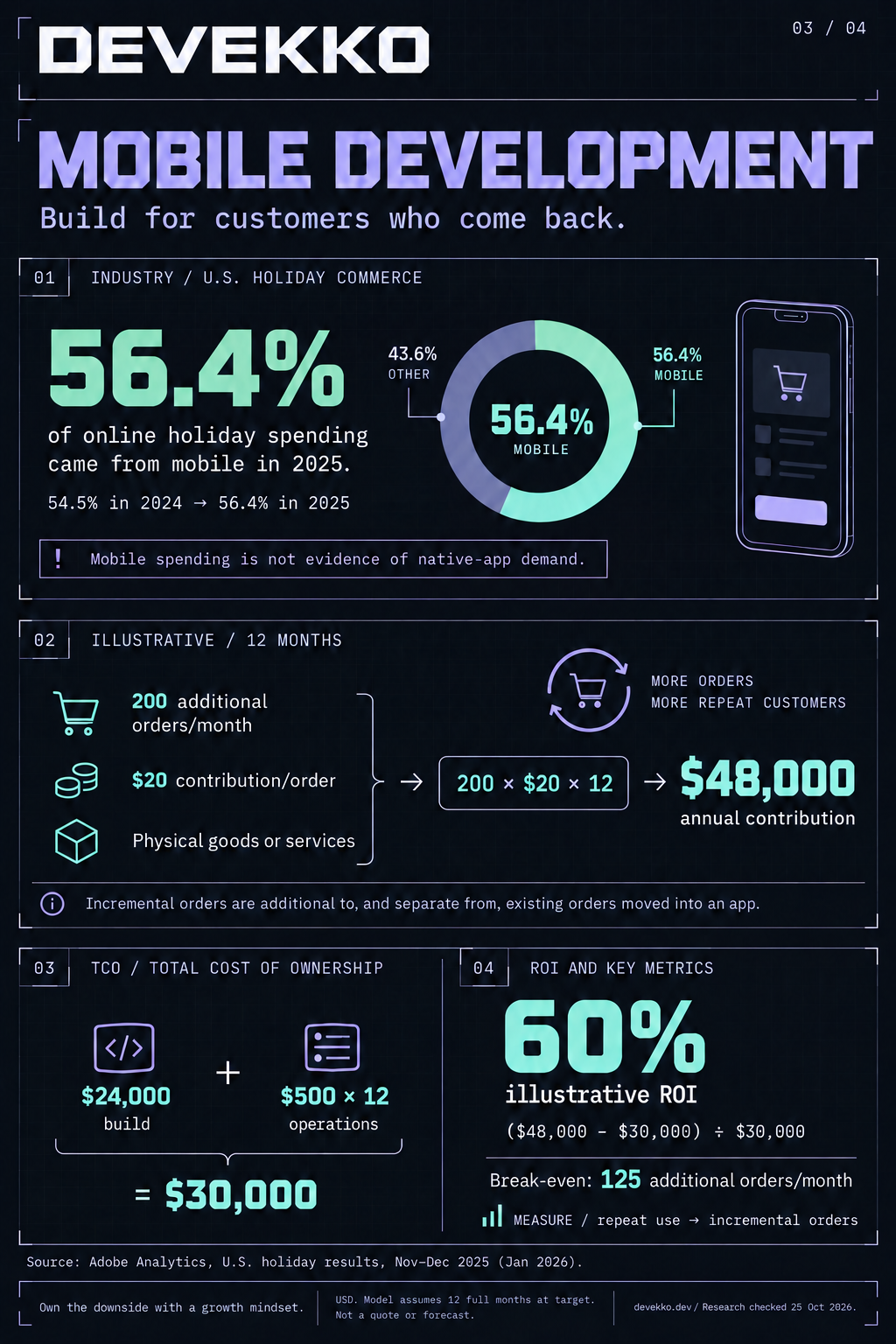
Mobile accounted for 56.4% of U.S. online holiday spending in November–December 2025, up from 54.5% in 2024. Mobile-device spending does not by itself establish demand for a native app.
Source: Adobe, 2025 holiday shopping results, January 7, 2026
How the illustrative model works
- Assumptions: 200 additional orders per month at $20 contribution per order.
- Contribution: 200 × $20 = $4,000 a month across 12 months.
- First-year ownership cost: $24,000 build + $500 × 12 operations = $30,000.
- ROI: annual contribution less $30,000, divided by $30,000 = 60%. Break-even: 125 additional orders per month.
- Orders that move from your website or phone channel into an app are not additional sales. Validate repeat use before committing to a native app; responsive web may meet the need.
If only half the benefit arrives: 100 additional orders per month: $24,000 contribution, −20% ROI.
Measure repeat use and incremental orders.
All amounts USD over the first 12 operating months. Not a Devekko client result, forecast, or price quote.
Start with the task people will return for
An app might let a customer manage a booking, help a member access a service, or guide a field team through a job.
We identify that recurring task first. Prototypes help you test the flow before the project expands into secondary features.
Build the experience and the systems behind it
- Accounts and permissions appropriate to your users.
- Booking, ordering, membership, or operational workflows.
- Connections to your web product and business systems.
- Notifications tied to useful events and user preferences.
- Offline behavior where the task and device requirements call for it.
- AI-assisted search or information processing when there is a clear use case.
The application backend connects customer accounts, business data, and suitable AI features through defined APIs and permissions. Device behavior and mobile releases are planned as their own parts of the project.
Choose the mobile approach around the requirements
Some services work well as a responsive web application. Others need an installable app, deeper device access, or a platform-specific experience.
We assess those needs before selecting the approach. The decision includes expected usage, device capabilities, accessibility, ongoing maintenance, and release requirements.
Make the first release testable
The delivery plan identifies priority flows, supported devices, API contracts, and acceptance criteria. It can include interactive prototypes, application development, backend integration, device testing, and store submission preparation.
We also plan what happens when connectivity drops, permissions are denied, or a service is unavailable. These states are part of the experience.
A few useful answers
Before we begin.
How is a project priced?
Pricing depends on the user flows, target platforms, backend integrations, and release requirements. We agree the deliverables and price in a proposal. A prototype can help resolve major questions before the full implementation is scoped.
Should we build for iOS, Android, or both?
Start with the devices your users have and the capabilities your service needs. We use those requirements to define the initial platform scope.
Can the app connect to our existing website?
It can share APIs and data where the existing systems support it. Discovery checks authentication, permissions, and integration constraints.
Can we add AI features?
A feature such as document search or an assistant can connect to AI through the application's backend. We agree on the data it can access and how users review its output.
Can you guarantee app-store approval?
Store approval remains with the platform operator. The project can include submission preparation and handling review feedback within an agreed scope.
What does ongoing maintenance involve?
Plan for operating-system updates, dependency changes, monitoring, and product improvements. Support coverage and release responsibilities belong in the engagement scope.
Your next project
Give the first version a clear purpose
Tell us who will use the app and the main task it should help them complete.