02 / Ecommerce development

Make buying easier, from product discovery to the next order.

Devekko builds and improves online stores around how your customers shop and how your team operates. Connect the storefront, product information, payments, and order workflows in one considered plan.

Discuss your store

Prior experience / Business priorities

Focus on the business measures that matter.

Founder experience across commerce, software delivery, and connected operations. For your project, turn that experience into a clear baseline, priorities, and measures of progress.

BUSINESS PRIORITY

Growth

Revenue quality

Prior work includes commerce roadmaps, storefronts, and connected customer journeys.

KPIs to consider

  • Net revenue
  • Purchase conversion
  • Average order value

Objective Grow sales while protecting contribution margin.

BUSINESS PRIORITY

Margin

Unit economics

Experience connects product decisions with the systems and workflows that support each order.

KPIs to consider

  • Contribution margin
  • Cost per order
  • Total cost of ownership

Objective Improve the contribution left after variable costs.

BUSINESS PRIORITY

Cash flow

Working capital

Prior responsibilities span commerce, inventory, and the movement of order and product data.

KPIs to consider

  • Inventory days
  • Stock availability
  • Cash conversion cycle

Objective Reduce cash tied up in stock while maintaining availability.

BUSINESS PRIORITY

Retention

Customer value

Experience includes mobile journeys, subscription products, onboarding, and adoption.

KPIs to consider

  • Repeat purchase rate
  • Customer retention
  • Revenue per customer

Objective Help customers find value and keep returning.

How we use these KPIs

Start with the business decision, then agree the calculation, data source, review period, and owner. Read growth alongside margin and cash flow; read efficiency alongside service quality. Targets depend on your baseline and operating model. We review progress against that baseline before deciding what to change next.

02 / The investment case

Grow the margin, not just the cart.

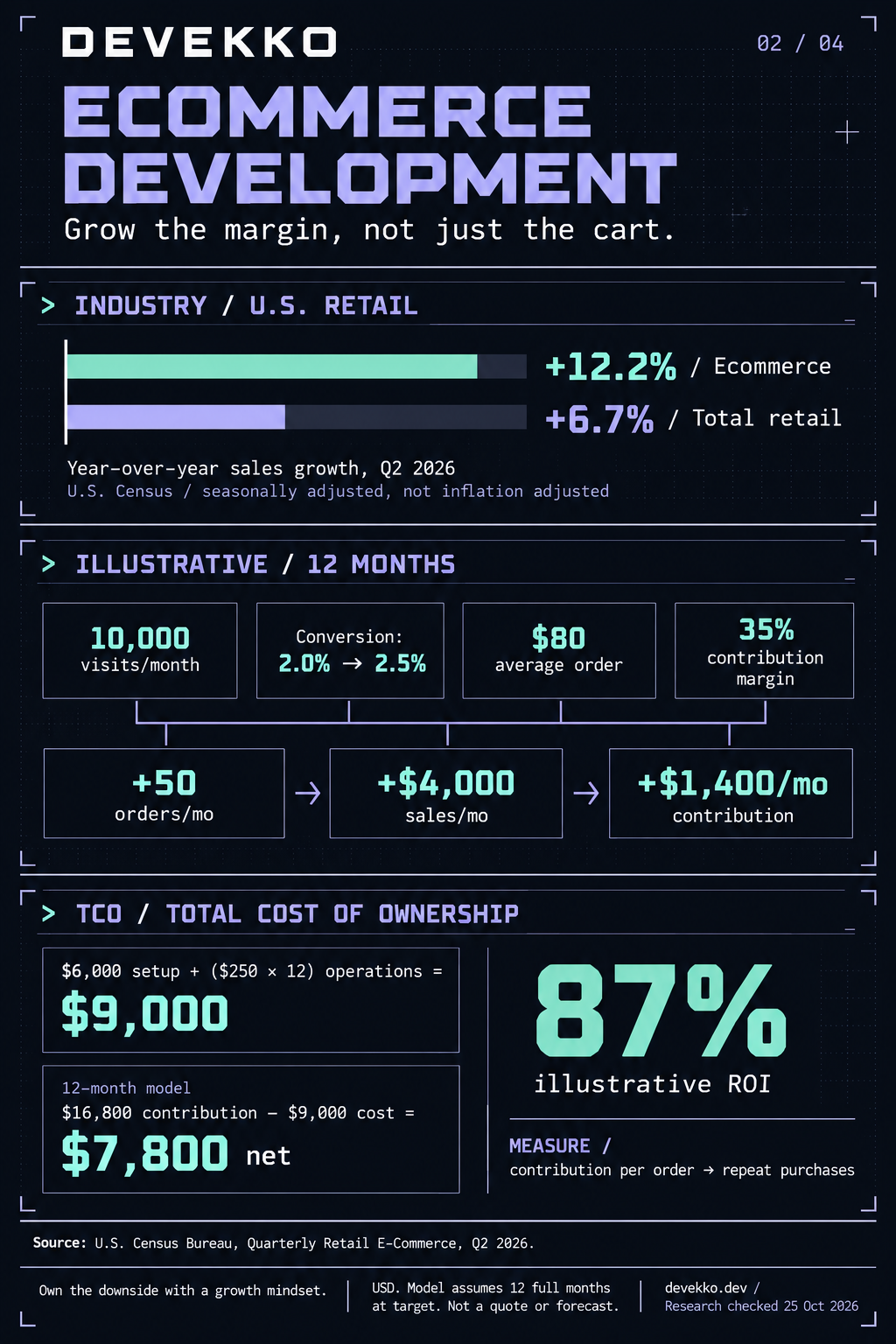
U.S. retail ecommerce sales grew 12.2% year over year in Q2 2026, against 6.7% for total retail (seasonally adjusted, not inflation adjusted; total retail includes ecommerce). Broad retail growth is context, not a forecast for an individual merchant.

Source: U.S. Census Bureau, Quarterly Retail E-Commerce Sales, Q2 2026

How the illustrative model works
  • Assumptions: 10,000 visits per month; conversion rises from 2% to 2.5%; $80 average order; 35% contribution margin.
  • Additional orders: 50 per month, or $4,000 sales and $1,400 contribution a month ($16,800 a year).
  • First-year ownership cost: $6,000 setup + $250 × 12 operations = $9,000.
  • ROI: ($16,800 − $9,000) ÷ $9,000 = 87%.
  • The margin must cover product costs, payment fees, fulfillment, returns, and variable acquisition costs. A real result could be lower or negative.

If only half the benefit arrives: Conversion reaches 2.25% instead of 2.5%: $8,400 contribution, −7% ROI.

Measure contribution per order and repeat purchases.

All amounts USD over the first 12 operating months. Not a Devekko client result, forecast, or price quote.

Download the infographic
Devekko ecommerce infographic compares U.S. ecommerce growth of 12.2% with total retail growth of 6.7% in Q2 2026. An illustrative checkout-conversion model yields $16,800 annual contribution against $9,000 ownership cost, or 87% ROI.
Illustrative model, researched October 25, 2026.
01 / Commerce

Look at the whole order

Customers need clear product information, useful search, and a checkout they understand. Your team needs accurate orders and a manageable way to keep the store up to date.

We map both sides. The first release focuses on the gaps that matter most to your customers and operations.

Planning a Shopify project? Explore our dedicated offering for migrations, store refreshes, and ongoing growth.

Shopify migration, refresh and growth

02 / Commerce

Build the store around your business

Storefront and product discovery. Organize categories, product pages, search, and filters so customers can find what they need.

Checkout and customer accounts. Define payment, account, and order-status flows using the capabilities of the selected commerce platform.

Subscriptions and repeat purchases. Plan recurring orders or memberships where they fit the offer, including billing state and customer management.

Catalog and operational integrations. Connect product, inventory, fulfillment, and CRM systems with clear ownership of each piece of data.

Store migration. Plan product and customer-data transfer, URL changes, payment constraints, and the transition between systems.

03 / Commerce

Give product information a useful AI layer

AI features can support product questions, semantic discovery, or draft catalog content for review.

The source matters. Product facts, prices, and availability come from your approved catalog and commerce systems. The experience must handle missing information and give customers a direct route back to ordinary browsing and support.

Explore AI and data

04 / Commerce

Agree on what will change

A store project begins with an audit or discovery phase, a prioritized scope, and an integration map. The delivery plan can cover design, implementation, migration, purchase-flow testing, analytics, and a launch checklist.

We define how the team will manage products and orders after launch, along with any ongoing support.

Planning a move? Use the commerce migration checklist to inventory your catalog, connected systems, URLs, and release checks before scoping the work. It is an editable plain-text planning aid.

Download the commerce migration checklist

A few useful answers

Before we begin.

How is a project priced?

Pricing depends on the storefront, catalog, checkout requirements, integrations, and migration work. We agree the deliverables and price in a proposal. Platform subscriptions, payment processing, and other ongoing costs are considered alongside the build.

Which ecommerce platform should we use?

We compare your current setup and requirements before recommending a platform. Catalog complexity, payment needs, integrations, editorial control, and operating cost all affect the decision.

Can you work with our current store?

An initial review establishes the platform's capabilities and constraints. It also helps determine whether targeted improvements or a larger rebuild are appropriate.

Can we sell subscriptions or memberships?

These can be included in the scope after checking billing-provider support, customer access rules, and the ways people should manage their plan.

Will you guarantee more sales?

Sales depend on the offer, traffic, pricing, and store experience. We define the behavior we are improving and measure the relevant steps after launch.

What happens to our old product URLs?

Migration planning includes a URL inventory and redirects to relevant new destinations. We also test product links and search metadata before launch.

Your next project

Plan a store that fits the next stage of your business

Share your current store or describe what you want to sell. Include any systems the store needs to connect to.

Discuss your store

Devekko / chat

AI project guide

Good ideas start with
a conversation.

Tell me what you’re building. I can help you find a starting point and the right Devekko service.

Automatic security check.

Enter to send · Shift + Enter for a new line

AI can make mistakes. Messages are processed by our AI service provider. Leave out private information. Privacy

Prefer a person?hello@devekko.dev